Diapers are one of the essential items in baby care today, but have you ever wondered about their history?
From the use of natural materials to today’s disposable versions, the history of diapers is a fascinating mix of innovation and surprising facts. Understanding how diapers evolved shows how a simple parenting tool can be improved through constant curiosity and creativity.
Diaper’s Early Beginnings
Thousands of years ago, before cloth or disposable diapers existed, parents had to use whatever materials were available to keep their babies clean.
Leaves, moss, and animal skins, wrapped and fastened in place, were considered the first “diapers.”
Although these natural materials could irritate babies and required constant cleaning, they represented the first steps in human ingenuity toward the diapers we know today.
The Birth of Cloth Diapers
By the 19th century, parents began using reusable cloth diapers made mainly from linen, cotton, or flannel, folded and secured with pins.
Cloth diapers have been popular for many decades and have served as the benchmark for modern diapers.
Why did cloth diapers gain popularity so quickly?
- They were simple to use: parents just washed and dried them, and they could be reused
- Unlike primitive diapers, which couldn’t be washed and often irritated the baby’s skin, cloth diapers could be boiled for extra hygiene, making them safer and more comfortable.
First Diaper Innovations
(Source)
In the late 1940s, American inventor Marion Donovan made a breakthrough in the diaper industry by designing a waterproof diaper cover made from a cut shower curtain.
- This innovation replaced dangerous safety pins in cloth diapers with snaps
- Donovan named her invention the “Boater,” because she thinks it looks like a boat, which effectively keeps babies’ clothes and bedding dry
- She is also credited with creating the prototype of the disposable diaper we see in stores today
Disposable Diapers
Cloth diapers remained the household favorite until the mid-20th century, when disposable diapers gained popularity, thanks to Donovan’s innovation.
- Practical disposable diapers combine waterproof covers and absorbent layers, making them more convenient.
- In 1961, Procter & Gamble introduced the first successful mass-produced disposable diaper
Disposable diapers revolutionized baby care:
- No more constant washing
- Better comfort for babies
- Improved hygiene
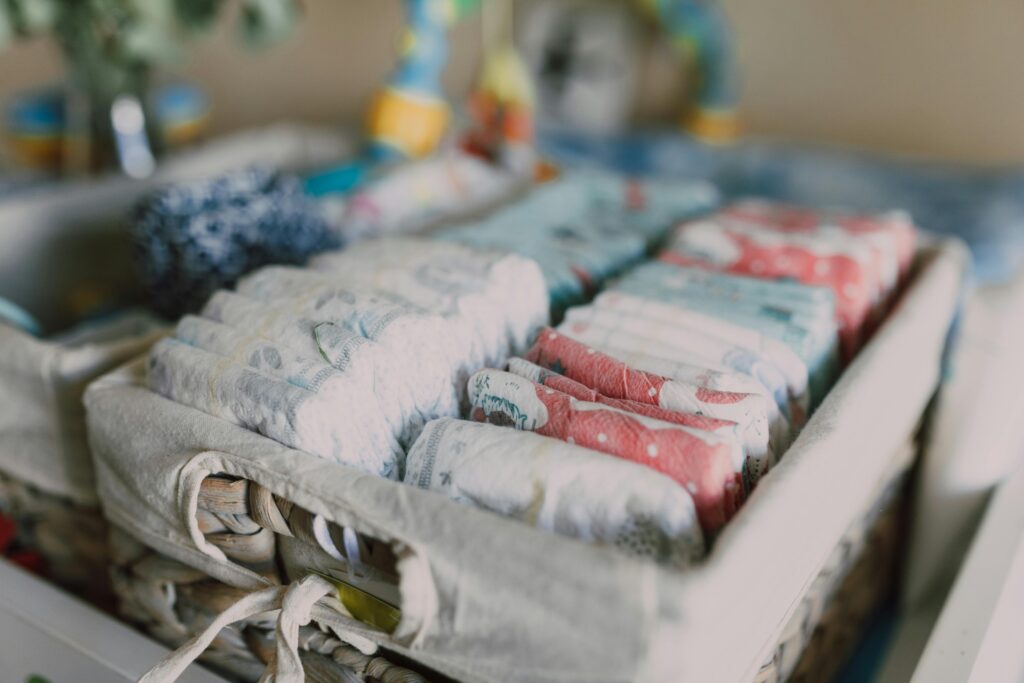
Today, disposable diapers remain the preferred choice for many parents who don’t have time for manual washing.
Modern Diapers and Innovations

(Source)
With continuous innovation, manufacturers introduced superabsorbent polymers in disposable diapers in the 1980s.
The use of superabsorbent polymers allows the diaper to be more absorbent and thinner compared to earlier versions.
Also, modern diapers feature adjustable tabs, elastic leg cuffs, and wetness indicators, which add comfort, better fitting, and are more gentle on babies’ skin.
Cultural and Environmental Considerations
While some parents still prefer cloth diapers due to environmental and financial factors, the majority worldwide choose disposable diapers for convenience.
Fun Facts About Diapers
- The word ‘diaper’ originally refers to a type of patterned cloth, not anything related to baby care products
- Marion Donovan held 20 patents, mostly for household inventions.
- On average, American babies use about 6,000 diapers before they are fully trained in using the toilet
- Due to plastic materials, a typical disposable diaper can take hundreds of years to break down
- There are disposable diapers that utilize plant-based materials
Takeaway
The history of diapers shows how a simple, daily necessity for babies has led to significant innovations over time.
From using indigenous materials and waterproof covers to the advanced disposable diapers we have today, each stage reflects human creativity and a desire to improve baby care products.
Whether you are a parent or not, let the history of diapers remind you of the centuries-long journey of refinement and adaptation. Indeed, if humans remain consistent, they can make wonders even in things as simple as baby diapers.